Why Does My Guinea Pig Have Crusty Eyes? Causes, Symptoms & Treatment Guide
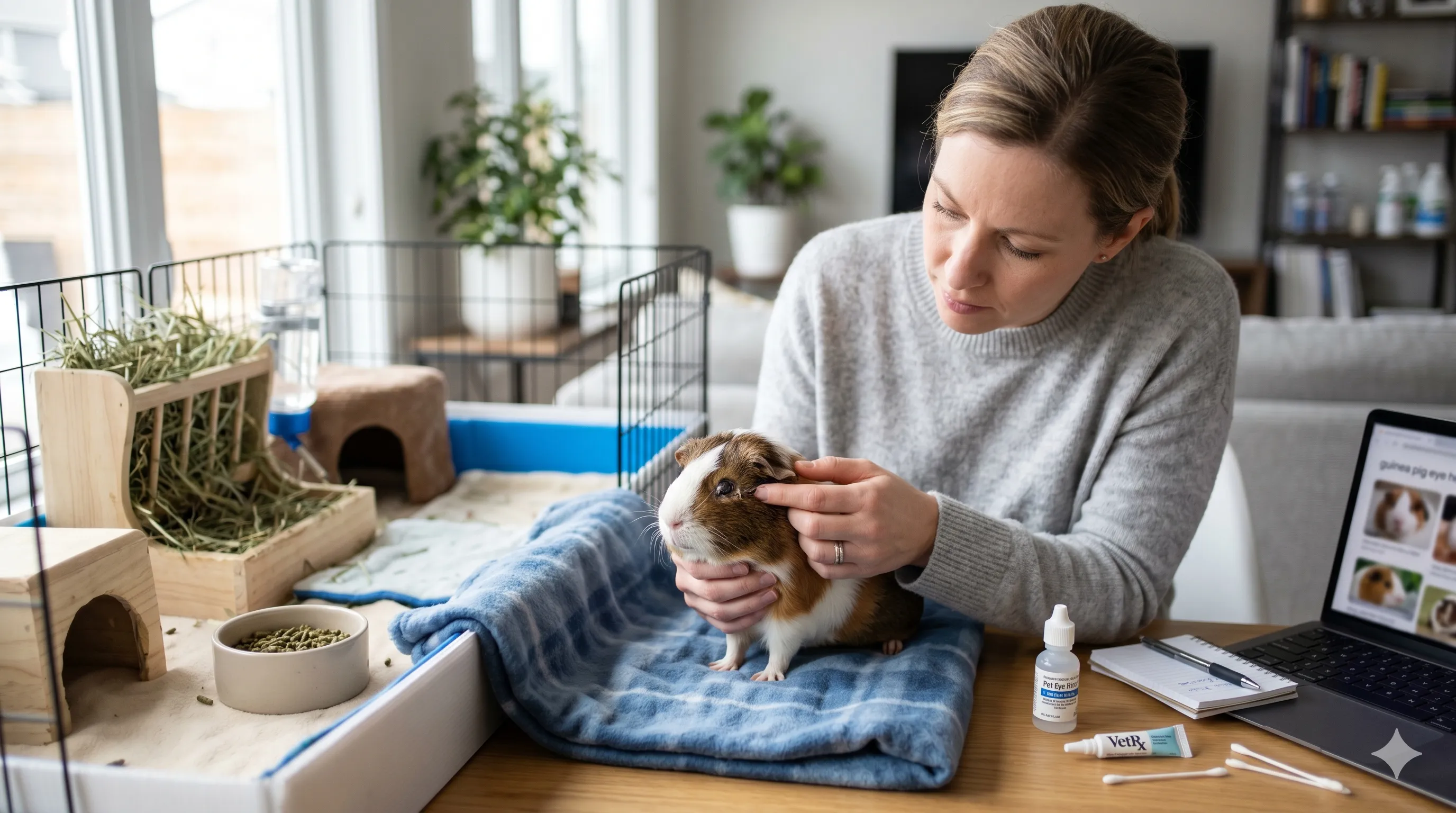
If you've noticed crusty material around your guinea pig's eyes, it's completely understandable to be concerned. While a…
Trusted by PetNurture pet parents
A guinea pig's daily Vitamin C need scales with body weight, age, and condition — roughly 10-26 mg per day for an average 1 kg adult guinea pig in normal health, rising to about 20-48 mg/day during pregnancy or nursing, since guinea pigs can't produce their own Vitamin C and rely entirely on diet.
Enter your guinea pig's weight, age group, and condition (normal, pregnant, nursing, or recovering) to get an estimated daily Vitamin C range.
Unlike most mammals, guinea pigs share a unique biological limitation with humans - they cannot synthesise Vitamin C internally. Understanding why this matters is the first step to providing optimal nutrition.
Guinea pigs lack L-gulonolactone oxidase, the enzyme responsible for converting glucose into Vitamin C (ascorbic acid). This genetic mutation, shared with humans and other primates, means the body has no fallback - all Vitamin C must come from the diet, every single day.
Vitamin C is essential for collagen synthesis - the structural protein that holds connective tissue, blood vessels, cartilage, and skin together. Without it, these structures break down, resulting in painful joint problems, slow wound healing, and weakened capillaries.
Vitamin C supports the immune system's white blood cell function, acting as both an antioxidant and an immune modulator. Guinea pigs with consistently low Vitamin C intake are generally more susceptible to respiratory infections and slower to recover from illness.
Vitamin C is a water-soluble vitamin - it is not stored in meaningful amounts in the body. This means a guinea pig that misses a day of Vitamin C-rich food cannot "catch up" easily. A consistent daily supply through fresh vegetables is the most reliable strategy.
The following symptoms are sometimes associated with Vitamin C deficiency (a condition historically known as scurvy). However, these symptoms may have many causes and should always be evaluated by a veterinarian. Do not attempt to self-diagnose.
These symptoms may have many causes and should be evaluated by a veterinarian. Do not attempt to self-diagnose Vitamin C deficiency based on this or any other online resource.
This tool does not diagnose any health condition. It is an educational reference only.
Fresh vegetables are the gold standard for delivering Vitamin C to guinea pigs. The following foods are excellent sources - the key is variety, freshness, and appropriate frequency.
One of the best sources available. Red bell peppers contain approximately 3× the Vitamin C of green ones. Remove seeds and white pith. Safe to offer daily - most guinea pigs love them.
Exceptionally high in Vitamin C and other nutrients. Flat-leaf and curly parsley are both suitable. Limit to 2-3 times per week due to calcium content, which can be a concern if fed in excess.
A nutrient powerhouse. High in Vitamin C, Vitamin K, and calcium. Suitable 2-3 times per week. Introduce gradually as some guinea pigs experience gas from cruciferous greens in large amounts.
A lower Vitamin C source but highly palatable and safe for daily feeding. A good daily green to include alongside higher-potency sources like bell pepper. Fresh only - never dried.
The florets are higher in Vitamin C than the stems. Offer 2-3 times per week. Some guinea pigs produce more gas from broccoli, so monitor after introduction and reduce if needed.
A popular treat with a useful Vitamin C hit. Limit to a small piece 1-2 times per week due to natural sugar content. Berries should never replace vegetables as the primary Vitamin C source.
Vitamin C-fortified pellets do contain ascorbic acid, but Vitamin C degrades rapidly once a bag is opened - exposure to air, heat, and light accelerates this process. Within a few weeks of opening, pellet Vitamin C content may be significantly diminished. Fresh vegetables should always be the primary Vitamin C delivery mechanism. If a vet recommends supplementation, use Vitamin C drops added directly to food or water freshly each day (not stored in the bottle for days), as ascorbic acid in solution degrades within 24 hours.
Even well-intentioned owners can inadvertently leave their guinea pig's Vitamin C needs unmet. These are the most frequent and fixable errors.
Many owners assume that a good quality pellet food provides all the Vitamin C a guinea pig needs. However, ascorbic acid in pellets degrades rapidly after opening. Pellets are a supplement to fresh vegetables - not a replacement. A guinea pig fed exclusively on pellets with no fresh greens is at nutritional risk.
While fruit contains Vitamin C, its high sugar content means it should be a very occasional treat - not a daily source. Overfeeding fruit causes excess sugar intake, diarrhoea, and weight gain. Bell peppers, not strawberries, should be the go-to Vitamin C source for most guinea pigs.
Vitamin C is destroyed by heat, light, and air exposure. Leaving bell peppers or parsley out at room temperature for hours before feeding significantly reduces their Vitamin C content. Store fresh vegetables properly and offer them promptly after cutting. Wilted vegetables are less nutritious than fresh ones.
Vitamin C in water solution degrades within 24 hours, making water-added supplements largely ineffective unless freshened daily. Supplements past their use-by date may provide negligible benefit. If supplementation is needed (under vet guidance), ask about Vitamin C directly on fresh food rather than in water.
Educational daily Vitamin C reference ranges for guinea pigs across different life stages and conditions. All figures are estimates based on widely referenced educational guidelines.
| Life Stage / Condition | Typical Daily Range | Level | Key Notes |
|---|---|---|---|
| Baby (0-6 months) | 10-20 mg/day | Normal | Growing rapidly; proportionally higher need per kg than adults |
| Young Adult (6 mo-2 yr) | 10-25 mg/day | Normal | Active growth phase; establish good dietary habits early |
| Adult (2-5 years) | 10-30 mg/day | Normal | Maintenance; consistent daily fresh vegetables are key |
| Senior (5+ years) | 15-30 mg/day | Normal | Ageing may affect absorption; regular vet checks recommended |
| Pregnant (female) | 20-40 mg/day | Elevated | Foetal development increases demand significantly |
| Nursing (female) | 20-40 mg/day | Elevated | Supports milk production and pup nutrition via milk |
| Recovery / Illness | 20-50 mg/day | Higher Support | Illness depletes reserves; consult vet before supplementing |
Educational reference ranges only. Individual animals may vary. These figures are not clinical prescriptions. The weight-adjusted calculator above provides a more personalised estimate.
Guinea pigs cannot synthesise their own Vitamin C — they lack the enzyme (L-gulonolactone oxidase) needed to make it from glucose — so daily dietary intake is essential. The estimate scales a base per-kilogram range by age and condition.
These figures are general educational reference ranges, not a veterinary prescription — individual needs can vary.
This tool provides an estimate, not a diagnosis. Keep these limitations in mind when reading your result:
How the daily Vitamin C range is estimated for a 1 kg adult guinea pig in normal condition.
Complete your guinea pig nutrition knowledge with these free companion tools.
General public resources referenced while researching this tool's topic.
This tool is part of PetNurture's educational library. Its formulas and guidance draw on publicly available educational resources, recognised veterinary organisations, and established animal welfare references where appropriate — see the References section below for the specific sources used on this page.
It is provided for general educational purposes and is not a substitute for advice, diagnosis, or treatment from a qualified veterinarian.
The information provided by this tool is for general educational and informational purposes only. Results are estimates, not a diagnosis, and may vary based on your pet's breed, age, health conditions, activity level, diet, and individual factors.
PetNurture does not provide veterinary, medical, or emergency care advice. Always consult a licensed veterinarian or qualified pet care professional regarding your pet's specific health, nutrition, or medical needs.
While we strive to keep calculations accurate and up to date, PetNurture makes no guarantees regarding completeness, reliability, or accuracy. Use this tool at your own discretion.
How we calculate results: This tool uses commonly referenced veterinary formulas, feeding guidelines, and breed-size estimates to provide general educational guidance. Individual pets may have different nutritional, behavioral, or medical needs that are not captured by any generalized formula.
Join our newsletter for simple care guides, feeding charts, and trusted product recommendations.